








Open Foris GeoID certified as a Digital Public Good
November 6, 2026
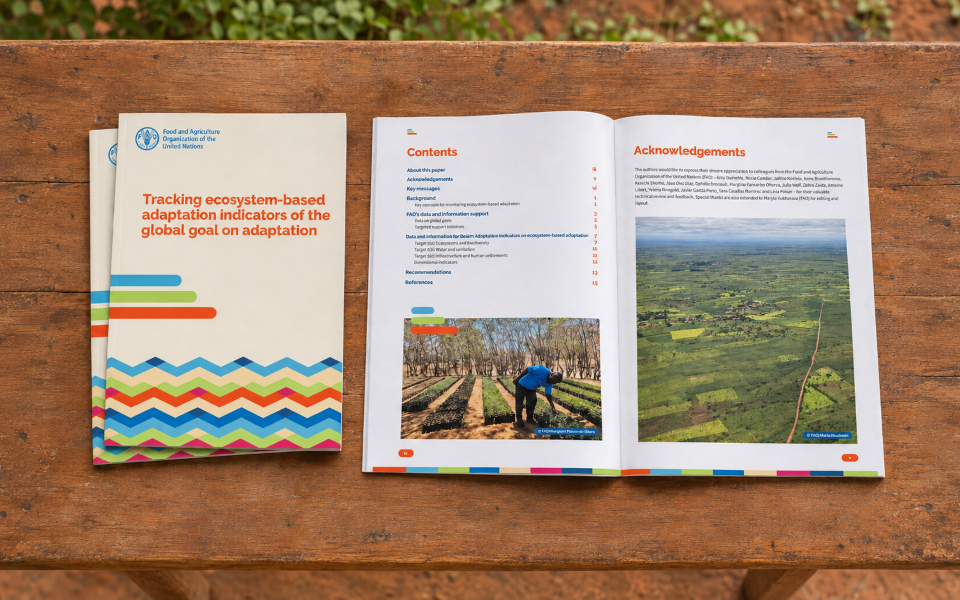
New FAO paper highlights opportunities to track progress on ecosystem-based climate adaptation
November 12, 2026

11/11/2026
Five years ago, the United Nations launched a global call to prevent, halt and reverse the degradation of ecosystems worldwide. Since then, countries, organizations and communities have expanded restoration efforts across forests, agricultural landscapes, rivers, wetlands, coastal and marine ecosystems. But how much has been achieved, and what needs to happen in the remaining years of the Decade?
A new report by the United Nations Secretary-General, submitted to the UN General Assembly last week, takes stock of progress under the UN Decade on Ecosystem Restoration (2021–2030) from its launch to mid-2026.
Prepared with contributions from the Food and Agriculture Organization of the United Nations (FAO), the United Nations Environment Programme (UNEP) and other partners, the report examines how international cooperation, technical support, monitoring systems and restoration initiatives have evolved. It also identifies the challenges that must be addressed to accelerate progress towards 2030.
From global commitments to action on the ground
Since 2021, the Decade, jointly led by FAO and UNEP, has grown into a global movement involving more than 300 partner organizations.
Among its achievements is the recognition of 35 World Restoration Flagships, highlighting large-scale initiatives that demonstrate how ecosystem restoration can deliver environmental and socio-economic benefits.
Together, these initiatives have committed to restoring 75.7 million hectares, with 18.1 million hectares already under restoration. The report also documents around 642,000 jobs created and more than 1.23 million people trained across the Flagships.
The initiatives cover diverse ecosystems and approaches, from natural regeneration and forest rehabilitation to the recovery of freshwater habitats and degraded agricultural landscapes. Their experiences offer practical lessons for expanding restoration while supporting local livelihoods.
The Decade has also strengthened the knowledge and technical foundations for restoration. Under FAO’s leadership, its Task Force on Best Practices has brought together expertise from 200 organizations to develop principles, standards and practical guidance for restoration practitioners and decision-makers.
Strengthening the systems that track restoration
An important part of the Decade’s work has been improving the availability and quality of information on restoration progress.
FAO coordinates the Task Force on Monitoring, a network of more than 600 experts from 150 organizations working to strengthen restoration monitoring at national, regional and global levels.
Central to this effort is the Framework for Ecosystem Restoration Monitoring (FERM), the official monitoring platform of the Decade. FERM brings together information from restoration initiatives and existing reporting systems, providing a clearer picture of where restoration is taking place and how it is progressing.
The report highlights FERM’s role in documenting the World Restoration Flagships, including their commitments, implementation status and areas under restoration. Its use of geospatial data also helps identify potential overlaps between reported areas and improves the reliability of global estimates.
Beyond measuring hectares, FERM supports the collection of information on restoration approaches, ecological outcomes and socioeconomic benefits, helping countries better understand the longer-term results of their efforts.
Supporting countries to monitor and report progress
The report also recognizes the work of the Task Force on Monitoring through the Target 2 Road Map, which supports a more coordinated approach to monitoring restoration under the Kunming–Montreal Global Biodiversity Framework.
The Road Map brings together partners working on ecosystem-specific guidance, data interoperability, Indigenous-led monitoring and national capacity needs. It helps countries improve reporting on Target 2, which calls for at least 30 percent of degraded ecosystems to be under effective restoration by 2030.
Through FAO’s AIM4NatuRe initiative, more than 40 countries have received technical support and capacity development to strengthen their monitoring and reporting systems.
These efforts respond to persistent challenges identified in the report, including differences in reporting methods, limited availability of comparable data and gaps in national monitoring capacities.
The priorities for the remaining years
The report’s findings align with and build upon those of the Restoration Progress Report: Nature’s Comeback, launched at CBD Cop-17 by FAO, UNEP and the Secretariat of the Convention on Biological Diversity (CBD). While Nature’s Comeback provides a detailed assessment of restoration progress, the Secretary-General’s report places these findings within the broader achievements and priorities of the UN Decade.
Both assessments highlight the need to accelerate implementation, strengthen monitoring and move beyond measuring restoration solely by area to better understand its benefits for ecosystems and people.
Looking towards 2030, the Secretary-General’s report calls for greater investment, stronger technical capacities, improved monitoring and more coordinated action across biodiversity, climate and land agendas. Particular attention is needed for ecosystems that remain underrepresented in restoration efforts, including freshwater, marine and coastal ecosystems, and agricultural lands.The first half of the Decade has helped establish partnerships, technical solutions and knowledge to support restoration worldwide. Building on these achievements, the remaining years offer an opportunity to expand effective restoration, strengthen accountability and ensure that efforts deliver lasting benefits for nature, climate resilience and livelihoods.